Financial Crime Detection | Anti-money laundering | Data driven investigations
  • Home
  • Solutions
  • Case work
  • About Us
  • News and Events
  • Contact us
  • Report a Crime
    • Report Crime Form

News and Events

Stablecoins Under Scrutiny in 2026: Why Regulators Are Targeting Illicit Use and What It Means for Compliance Intelligence

4/3/2026

0 Comments

 
Picture
1. Stablecoins in the Regulatory Crosshairs in 2026

For years, stablecoins were viewed as a bridge between traditional finance and blockchain innovation. In 2026, global watchdogs are issuing a stark warning: stablecoins are now the most frequently abused virtual asset for illicit finance, sanctions evasion and money laundering.
In its latest public statement, the Financial Action Task Force (FATF) flagged stablecoins as the most popular virtual asset used in illicit transactions, accounting for a disproportionate share of suspect activity on-chain. The watchdog noted stablecoins comprised approximately 84% of illicit virtual asset transaction volume in 2025, often tied to sanctioned actors and cross-border evasion tactics. The total estimated value of such activity was tracked in the trillions per month range last year.
This marks a seismic shift in how stablecoins are perceived by regulators — not as benign liquidity tools, but as significant risk vectors for AML/CFT frameworks.


Picture
2. What Regulators Are Concerned About

Several specific patterns have raised concern:
  • Sanctions Evasion: Bad actors tied to sanctioned jurisdictions like Iran and North Korea are using stablecoins to move value across borders while attempting to hide origins.
  • Peer-to-Peer Transaction Gaps: Stablecoins moving through unhosted wallets (wallets not held by regulated intermediaries) evade standard AML/KYC controls, undermining oversight.
  • High Velocity Flows: With overall stablecoin transaction volume exceeding $1 trillion per month in 2025, enforcement agencies are struggling to reconcile volume with actionable risk signals.
Regulators are now urging countries to impose AML obligations directly on stablecoin issuers and consider enhanced controls such as wallet freezing mechanisms and contractual restrictions embedded in smart contracts.


Picture
3. Enforcement Trends Reflect Escalating Risk Priorities

The shift in focus is not abstract — enforcement activity underscores the seriousness of these concerns:
  • US Prosecutors are actively pursuing crypto forfeiture actions tied to scams where stablecoins like USDT were central to laundering and movement of illicit funds. In one recent case, prosecutors sought the forfeiture of over $327,000 worth of USDT linked to a 2024 romance scam, illustrating how stablecoins remain intimately connected to fraud ecosystems.
  • Authorities globally are investigating major exchanges for potential sanctions violations related to crypto transactions, including stablecoin flows, with some lawmakers in the US calling for deeper probes into platforms like Binance.
  • In parallel, jurisdictions like the EU, UK, and Australia continue to refine AML frameworks that explicitly integrate digital assets — including stablecoins — into their supervision mandates.
These developments signal a broader enforcement era in which virtual asset compliance is now central to global AML priorities.


Picture
4. Why Traditional AML Tools Fall Short Against Stablecoin Risks

Stablecoins inhabit a gray zone between traditional finance and crypto rails. Legacy AML tools are typically transaction-centric — focusing on individual tranches of movement or simple rule-based thresholds.
But stablecoin use in illicit finance reveals three core challenges that traditional systems struggle with:
  • High-volume, low-value dispersion: Criminal funds are split across many micro-transactions that evade threshold flags.
  • Cross-chain obfuscation: Movement across multiple ledgers complicates pattern recognition.
  • Sanctions layering: Combining stablecoins with sanctioned entities requires network-level analysis, not isolated alerts.
These challenges demand a fundamentally different analytical architecture — one focused on network intelligence, entity relationships and cross-domain signal correlation.

5. Intelligence-First Compliance: The Competitive Edge

This is where AMALIA 2 by RisikoTek delivers measurable value for compliance and risk teams:
Network Intelligence:
AMALIA 2 builds multi-layered relationship graphs linking wallets, entities, counterparties and risk attributes — essential when stablecoin flows cross jurisdictional and custodial boundaries.
Cross-Domain Correlation:
By ingesting data across blockchain transactions, sanctions lists, corporate registries and AML/CFT records, AMALIA 2 identifies complex laundering patterns that siloed systems miss.
AI-Assisted Anomaly Detection:
Beyond static rules, machine learning surfaces emergent risk patterns, including layering, looping and peer-to-peer flows that are characteristic of stablecoin misuse.
Actionable Investigation Outputs:
Rather than raw alerts, AMALIA 2 produces contextual investigations ready for reporting, enforcement support and remediation — helping teams act quickly in today’s heightened scrutiny environment.
In an era where stablecoin compliance is considered a priority risk domain by global regulators, intelligence technologies are no longer optional but necessary.

Call to ActionStablecoins now sit at the intersection of innovation and enforcement risk. Ready your compliance strategy for the next wave of AML expectations.
👉 See how AMALIA 2 by RisikoTek provides the intelligence foundation modern risk teams need.
📩 Email: [email protected]
🌐 Visit: www.risikotek.com
0 Comments

Why Banks Still Fail at Financial Crime Detection — And What Modern Risk Intelligence Must Fix

25/2/2026

0 Comments

 
Picture
Over the past year, global regulators have issued billions in penalties against financial institutions for anti money laundering failures.
One recent report showed that a single enforcement case alone reached nearly $1 billion, reshaping global rankings of AML penalties and highlighting how regulators are becoming more aggressive across jurisdictions.
From Europe to the Middle East to Asia, enforcement intensity is not slowing down.
If anything, it is accelerating.
And that raises an uncomfortable question for the financial industry:
Why do institutions continue to fail despite spending billions on compliance?
After decades inside banking and risk management, the answer is clearer than many executives would like to admit.
The problem is not effort.
The problem is architecture.

The Illusion of Compliance StrengthMost large institutions believe they are protected because they have:
• Transaction monitoring systems
• Sanctions screening tools
• KYC procedures
• Internal audit teams
• Compliance departments

On paper, this looks robust.
In reality, these systems are often fragmented, outdated, and disconnected from real world criminal behavior.
Financial crime today operates as networks, not isolated transactions.
Traditional compliance systems were never designed to detect networks.
They were designed to detect rule breaches.
That difference matters enormously.

Hero Banner Image PromptA cinematic scene inside a modern bank vault where stacks of money are dissolving into glowing digital data streams, revealing hidden red network connections underneath. A financial investigator silhouette stands in the foreground analyzing holographic risk graphs. Corporate, dramatic lighting. Gradient color theme from dark navy (#123D65) to bright orange (#F15A22). Ultra realistic, high contrast, professional fintech style.

Financial Crime Has Become a Data ProblemCriminal organizations now operate using:
• Shell companies across jurisdictions
• Trade based laundering structures
• Crypto enabled payment layers
• Professional facilitators
• Complex ownership chains

This creates a reality where risk is hidden inside enormous datasets.
The institutions that fail are not necessarily careless.
They are blind.


Picture


The Real Weak Point: Investigation SpeedAnother major issue regulators repeatedly identify is delayed detection.
Financial crime investigations often take:
• Weeks to identify patterns
• Months to build evidence
• Years before enforcement actions
By the time institutions understand what happened, damage is already done.
Modern financial crime moves faster than traditional investigation frameworks.
This is where technology must evolve.

Why Risk Intelligence Is the Missing LayerCompliance tools monitor activity.
Risk intelligence explains behavior.
That distinction is critical.
Next generation platforms must combine:
• Network analytics
• Corporate intelligence data
• Trade data analysis
• AI assisted investigation workflows
• Behavioral pattern recognition
• Cross border entity resolution
The goal is not just detection.
The goal is understanding risk before it escalates.

Picture

The Strategic Shift Banks Must MakeThe institutions that succeed in the next decade will not be those with the largest compliance teams.
They will be those with the smartest intelligence systems.
This requires moving from:
Reactive compliance → Predictive intelligence
Manual investigation → AI assisted workflows
Data silos → Integrated risk ecosystems
This is precisely where advanced investigative platforms such as AMALIA 2 are transforming the landscape.
By combining financial crime expertise with data science, institutions gain:
• Faster detection of hidden networks
• Stronger investigative evidence
• Reduced regulatory exposure
• Improved operational efficiency
Most importantly, they gain confidence.

A Banker’s PerspectiveHaving spent years inside global financial institutions, one reality becomes clear:
Regulatory risk is no longer a compliance issue.
It is a strategic risk.
Institutions that fail to modernize risk intelligence will continue to face:
• Financial penalties
• Reputational damage
• Operational disruption
• Executive liability
Those that adapt early will lead.

The Future of Financial Crime PreventionFinancial crime is evolving into a data science challenge.
The winners will be organizations that combine:
Technology
Intelligence
Human expertise
The tools exist.
The question is whether institutions are ready to use them.

If you are a financial institution, regulator, or investigative team exploring how advanced risk intelligence can strengthen your financial crime defenses, we invite you to connect with us.
Learn more about AMALIA 2:
https://www.risikotek.com/
Or contact our team directly:
[email protected]
0 Comments

DISRUPTION IN IP LES Jahrestagung 2026

24/2/2026

0 Comments

 
Picture
The European IP Landscape Is Changing. Are You Ready?
Cross border enforcement. Strategic litigation shifts. AI entering patent practice.
The conversation around IP disruption is no longer theoretical. It is operational.
We are proud to share that Elke Biechele, CEO of ALTIX, will be speaking at the LES Jahrestagung 2026 in Düsseldorf.
During the session “Industrie – Litigation Game”, leaders from Bayer, Amazon, ZTE, and Nivalion will explore how companies are adjusting their litigation and licensing strategies in a rapidly evolving European patent environment.
📅 04–05 March 2026
📍 Düsseldorf, Germany

If you are active in patent litigation, licensing, IP strategy, or legal finance, this discussion directly impacts how you position your next move.
What topics do you believe deserve more attention in this forum?
What questions should be raised during the panel?

Share your thoughts below or message us directly. We would be glad to bring your perspective into the discussion.
#IPLaw #PatentLitigation #LicensingStrategy #IntellectualProperty #LegalInnovation #EuropeanPatents #LitigationFinance #LegalTech #LES2026
0 Comments

February 19th, 2026

19/2/2026

0 Comments

 
Picture

Why 2026’s $17B Crypto Scam Surge Is a Banking‑Level Risk — An AML Intelligence Perspective

1. A Historic Shift: Crypto Scams Hit $17 Billion in 2025

According to the 2026 Crypto Crime Report, an estimated $17 billion was lost to crypto scams and fraud in 2025, an alarming surge that reflects a shift in criminal tactics and scale in the digital asset ecosystem. Impersonation scams skyrocketed by over 1400 percent year‑over‑year, and AI‑enabled fraud was cited as dramatically more profitable than traditional criminal activities.

Unlike isolated hacks or individual phishing attempts, these scams now resemble organized financial crime operations, operating with efficiency and infrastructure more akin to regulated industries than fringe threats.
Picture
2. From Brick‑and‑Mortar Risk to Digital Systemic Risk

In my two decades in banking and risk management — spanning established institutions across Europe and Asia — we saw risk evolve from credit default and market volatility into complex transactional and behavioral threats. Today, the digital asset ecosystem presents similar systemic risk challenges:


  • Industrialized scam networks: exploitable at scale
  • AI‑enabled schemes: increasing sophistication of attacks
  • Cross‑chain laundering flows: blurring boundaries between regulated and unregulated finance


These are not incremental threats — they are systemic shifts that require rethinking how risk is detected, managed and mitigated within institutions that now operate at the intersection of traditional finance and digital asset markets.

3. Banking Meets Crypto: A Compliance Collision Course

Just as banks in 2026 are modernizing AI, data infrastructure and cross‑domain governance to defend against emerging threats, regulatory expectations are rising simultaneously. The Thomson Reuters Institute’s recent global compliance outlook listed AI, crypto and data privacy among the top compliance concerns for 2026.

From a regulator’s lens, the goal is clear: detect, disclose, deter. But enforcement alone — even with record‑breaking penalties hitting financial institutions and fintechs — won’t stop increasingly sophisticated networks that blend technology, anonymity and rapid execution.

What banks once did with credit risk models, we now must do with crypto behaviour risk models — and that’s a fundamentally different challenge.
Picture
4. The Limits of Traditional AML & How Intelligence Bridges the GapConventional AML controls — threshold triggers, static watchlists and siloed monitoring — were never designed for adaptive, networked threats. Traditional systems are reactive. They trigger after the fact or flag individual anomalies without context — often leaving investigators with false positives and blind spots.
This is where the intelligence gap appears: criminals are using AI, social engineering, and interconnected platforms to orchestrate multi‑vector, stealth campaigns that evade straightforward rule‑based systems.
Addressing this gap requires:

  • Network‑aware detection (seeing entity linkages across systems)
  • Cross‑domain signal correlation (blockchain, KYC, sanctions, trade data)
  • AI‑assisted pattern recognition that evolves with threats


From my banking experience, the most effective risk controls are predictive, not just preventative — they forecast behavioural shifts before they crystallize into actual loss.


Picture
5. AMALIA 2: The Intelligence Engine for Today’s Compliance RealityThis is where AMALIA 2 by RisikoTek matters — not as another monitoring tool, but as an intelligence platform tuned to modern financial crime risk.
Entity Relationship Graphs: AMALIA 2 builds dynamic network maps linking wallets, counterparties, intermediaries and sanctioned entities — revealing hidden clusters that conventional methods miss.
Multi‑Source Correlation: Risk signals from blockchain transactions, internal compliance systems, sanctions lists and open‑source intelligence are correlated into a unified framework for real‑time insight.
AI‑Enhanced Detection: By combining machine learning with domain‑specific risk models, AMALIA 2 identifies emergent patterns in behaviour, not just rule violations.
Actionable Intelligence Outputs: Rather than raw alerts, AMALIA 2 delivers context‑rich insights that investigators and compliance leaders can act on decisively.
These capabilities align with cutting‑edge academic research that demonstrates the need for scalable, interpretable graph‑based intelligence in AML workflows — a shift from legacy approaches to true behavioural insight.

The sophistication and volume of crypto crime in 2026 demand a new category of AML intelligence — one that sees networks, patterns and relationships, not just transactions. 👉 See how AMALIA 2 by RisikoTek empowers your risk and compliance team with modern intelligence.
📩 Email: [email protected]
🌐 Visit: www.risikotek.com

0 Comments

Stop Scams Before They Start: Project Blacklight is Coming to GASS Asia & Operation Crypto Shield

18/8/2025

0 Comments

 
Picture
Picture
The fight against financial crime and online scams is a global battle that requires innovation, collaboration, and a new approach to intelligence. As financial crime professionals, law enforcement agents, and fraud investigators, you know that the traditional methods of name screening and data analysis are no longer enough to keep pace with sophisticated criminal networks.

This is why Project Blacklight is excited to announce our participation in two landmark events this year: the Global Anti-Scam Summit (GASS) Asia 2025 and Operation Crypto Shield Week of Action in September 2025. We invite you to visit our booth and experience a breakthrough in privacy-first, image-based fraud detection.

What to Expect from us
At both events, we will demonstrate the power of our "Blind Matching" technology. Forget the risks associated with conventional facial recognition. Project Blacklight is built on a simple yet revolutionary principle: your data stays with you.

Our system uses a proprietary "Hashing & Salting With Encryption" process to create an anonymized, secure data template. This means that no image or personally identifiable information (PII) ever leaves your domain. Only the anonymized identifier is matched against our extensive database of known criminals and scammers.

Here’s what you can look forward to seeing:
  • A live demonstration of our privacy-first technology. See firsthand how we can provide a definitive match without compromising the privacy of your customer data or violating regulations like GDPR.
  • The power of image-based intelligence. Learn why faces are a more accurate and reliable data point for identifying individuals than names. See how our system can help you overcome the challenges of name variations and fuzzy matching.
  • Actionable intelligence at your fingertips. Our technology doesn't just provide an alert; it generates actionable intelligence that can be used for investigations and prosecutions. We'll show you how to streamline your due diligence and reduce investigation time from months to minutes.

​

A Collaborative Approach to a Global Problem
Project Blacklight is not a solo endeavor. Our work is the result of a powerful partnership with leading experts in their fields, bringing together a unique combination of technology and human expertise.

We are proud to partner with:
  • RisikoTek: With their advanced financial crime intelligence engine, they provide the deep analytical capabilities that are critical for complex investigations.
  • Centinel: Trusted authority in counter terrorism, Centinel drives clarity, shapes strategy, secures communities.
  • Cognilyt: Our partnership with Cognilyt ensures we are leveraging cutting-edge AI and data integration to deliver the most effective and efficient solution possible.


We believe that by combining our expertise, we can turn the tide on financial crime. Our joint effort is designed to provide you with the tools you need to stop scammers and criminals before they can cause harm.

Join us at the Global Anti-Scam Summit (GASS) Asia 2025 and Operation Crypto Shield Week of Action in September 2025. Let’s face the facts and build a safer, more secure future together.

For more info contact us at [email protected]

0 Comments

RisikoTek featured as Anti Money Laundering expert in ABC documentary on counterfeits.

1/3/2024

0 Comments

 
Excited to share that the ABC documentary on counterfeits where RisikoTek has been featured in its capacity as the Anti Money Laundering expert is out now!
The documentary was aired live on Australian ABC TV last night at prime time. As per the producers, the show was one of the most watched in Australia and the online piece was the most read in the country!
0 Comments

February 21st, 2024

21/2/2024

0 Comments

 
RisikoTek is featured in our capacity as the Anti Money Laundering Expert adviser in this Documentary on ABC Australian TV. We are discussing the situation in Manchester where counterfeits are openly sold as well as the wider detrimental effects involving drugs, arms leaving a trail of money laundering behind.

​The documentary will be aired on 29th February 2024 at 8pm Sydney time / 5pm SG time. It is available on ABC TV and ABC iView app for android and ios.

The documentary is a thriller demonstrating the counterfeiting problem letting the audience participate live in an exciting police raid and allowing to understand the powers of the flow of money behind the sellers of counterfeits. Exciting watch!!
0 Comments

RisikoNews

20/9/2023

0 Comments

 
Dear Esteemed Readers,

We are delighted to present the inaugural edition of RisikoNews, marking the commencement of an ongoing series of informative updates. Our objective in this endeavour is to disseminate the most current news, fostering constructive dialogue within our community, with the ultimate aim of refining and presenting enhanced solutions for your benefit.


In the current landscape, artificial intelligence (AI) has gained ubiquity, serving both as a valuable tool and, regrettably, occasionally falling victim to misuse. Given this context, we believe it would be advantageous to acquaint you with our ongoing initiatives within this sphere. Following your consideration of the information provided below, if the "ATTENTION! project" resonates with you and arouses your interest, we cordially invite you to express your keenness to engage further. Subsequently, we would be delighted to coordinate a follow-up meeting, during which we can engage in a comprehensive discussion regarding the prospective avenues for your active participation and valuable contributions in this endeavour.

***
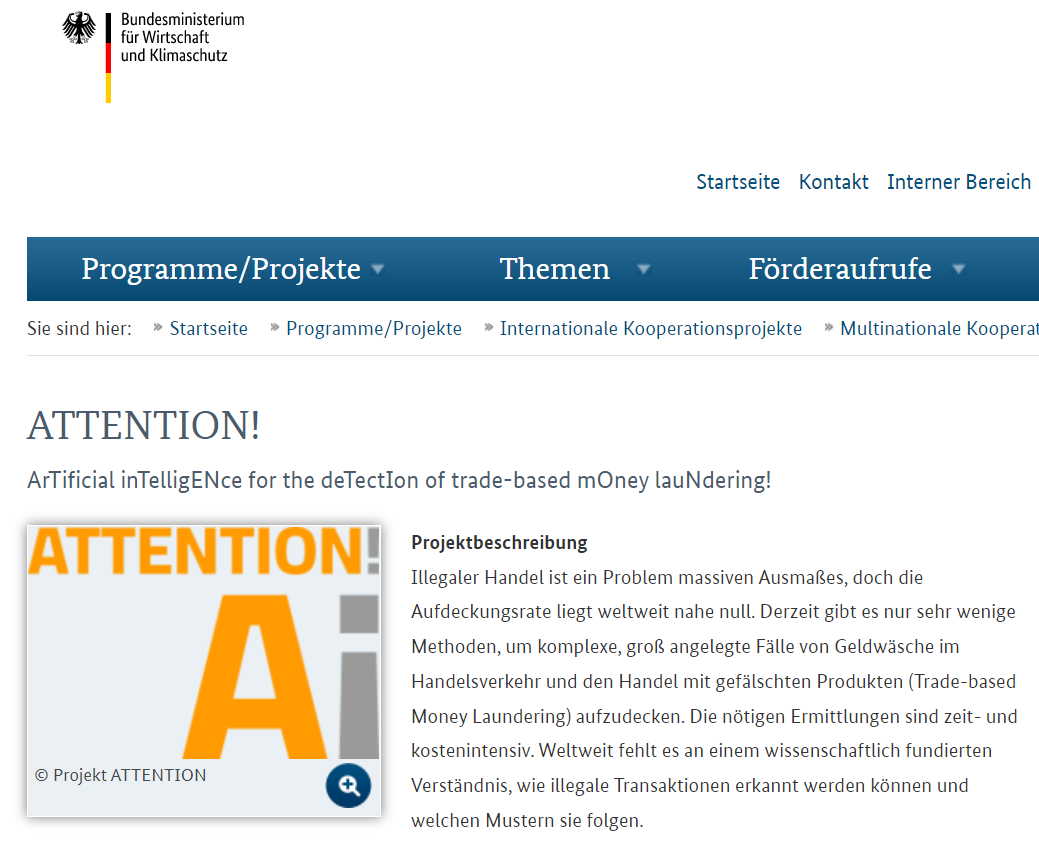
ATTENTION!
Building an AI-empowered system for the detection and persecution of illicit trade
Illicit trade is a problem of massive scale. Smuggling, counterfeiting, mis-invoicing, and money laundering deprives states and societies of taxes, infringes on product and brand rights, compromises product safety – and finances crime. Global Financial Integrity found a gap of US$8.7 trillion in reported trade that ultimately flow into criminal ventures, yet the detection rate is near zero.
Currently there are very few tools available to detect complex, large scale illicit trade and its perpetrators. Investigations are time- and cost intensive. Law enforcement often relies on tip-offs while customs must do random checks. Globally we are lacking a science-based understanding of how illicit transactions can be detected, what patterns they are following and how the networks behind them can be traced and persecuted.
The ATTENTION! project will analyse the largest trade databases available globally together with extensive Web content and metadata. ATTENTION! will develop Machine Learning models to understand and detect patterns of illicit trade activity and to expose the perpetrators and their support systems.
The trade activity of over forty countries over six years will be analysed comprehensively to ensure that all known smuggling methods such as co-mingling are included in the AI and ML models. The Web will be scanned for identified patterns to find new cases and detect the networks of perpetrators and their ecosystems integrating a vast array of 3rd party data sources.
Ultimately, the result of ATTENTION! will be a cloud software system that will empower companies and authorities to better detect illicit trade and proceed against its agents.
For more information, see: https://attention-project.eu/en/
***
We trust that you found our inaugural issue to be engaging and informative. We highly value your insights and input, which we warmly invite you to share with us. As we possess an array of resources at our disposal, we are eager to tailor our forthcoming editions to align with your specific interests.
Allow us to provide a brief overview of some of the tools at our disposal, which we can utilise to craft content that resonates with your preferences or propose something new:
AMALIA is an easy to use automated intelligence analytics software built for Enhanced Client Due Diligence and Case Investigations.
Space Detective is a unique tool which lets you monitor your areas of interest using satellite imagery.
The Trade Data Analysis Dashboard allows investigators to visualise and derive insights from shipping data.

Please do not hesitate to specify your preferences or suggest a particular subject that you would like us to explore in our next edition. Your feedback is invaluable in helping us tailor our content to meet your expectations and interests effectively.

Thanks for reading it, have a nice day &
Kind regards!


0 Comments

What is money laundering and how does Singapore guard against it?

18/8/2023

0 Comments

 
Picture
Recently in one of the biggest money laundering probes in Singapore, the police arrested several individuals involved in laundering money from overseas crimes and forgery. Read on in this informative article, as our CEO Elke Biechele talks to TODAY about the mechanics and perils of money laundering and why Singapore is so attractive to money launderers.
 
https://www.todayonline.com/singapore/explainer-what-money-laundering-and-how-does-singapore-guard-against-it-2235126      
0 Comments

Shop Owners in Search for a Magnificent Seven!

10/8/2023

1 Comment

 
Many fans of the western movie genre will be familiar with the 1960’s hit The Magnificent Seven. It even has a 2016 version starring every major motion picture star you can think of (Denzel Washington, Manuel Garcia-Rulfo, etc..). This classic tale tells of how a band of 7 hired guns save a town from a huge marauding gang that is exploiting and terrorizing a small town. 

Insight Crime recently produced an incredible piece on how Mexican organized crime uses the same methods of intimidation and violence, to force entire States of Mexico to buy tobacco products only from them. By doing so, choice of cigarettes and other tobacco products are simply blocked from the market. So long to free market access! 

The corporate black hat wearing bandidos in this instance are Tobacco International Holdings (TIH) and Burley & Virginia Tobaco Company. This new “Tobacco Cartel'' uses some pretty extreme “sales” methods to grow their business and it is no doubt from the influence of their partners in business the one and only Cartel de Jalisco Nuevo Generacion (CJNG). 


“An Offer You Can’t Refuse” 

If you were wondering how small shop owners in Mexico were being terrorized, well here is how. CJNG, seemingly with the consent of corrupt government officials, use the same market grabbing techniques that they use in the illegal drugs trade – overwhelming intimidation and when needed violence. It’s the only technique that they are familiar with, and that is unfortunate for the already traumatized population of Mexico.  

On the retail sales side of things the violent methods are well documented. Men dressed as police show up and tell the owner to destroy all cigarettes that they have. Once all that is destroyed the shop owner is forced to buy cigarettes only from the cartel. In 2018 when there was an investigation done on this by Milenio, they cited 300 cases of this intimidation. The poor shop owners were told, “if you sell again, you will be killed.” This horrifying practice was further demonstrated in Michoacan State according to reports in Milenio with instances of actual kidnapping!


Who’s the Sheriff in this Town? 

The Sheriff sadly is part of the scheme it seems. There is evidence of links between the Mexican Attorney General’s Office, TIH and CJNG. The more obviously linked individuals are Carlos Cedano Filippini and Genaro Cedano Filippini, both brothers formerly worked under the Attorney General's Office -which was then named Procuraduría General de la República (PGR)-. Carlos as well as others in the Filippini family are employed in various capacities in TIH. On the surface nothing fishy, but the same family has a criminal record of involvement with organized crime. Carlos himself has been in prison in the U.S. for organized crime offenses.  So, when it comes to calling the cops for help? Remember that shop owner intimidation came from people dressed as police? Maybe these “cartel agents” were not genuinely police, but the message is clear. 

​
Where There’s Smoke There’s Fire

Cigarettes may not gather as much passion for public action as other products. In Mexico there have been several studies online that show overall the smoking rates of the public in decline. That said, organized crime has changed the rules across the board when it comes to cigarettes. On top of the monopolization of cigarette selling outlets, they’ve also worked on the verticals using the same criminal techniques that work for drug trafficking. 

Cigarette smoking decline is linked heavily with increased government taxation policies. Tax more? People lower their demand because the price of the luxury goes up. Organized crime uses smuggling to evade import taxes. That allows them to sell cheaper and at the same time weakens law enforcement budgets. In the Insight Crime article, that illegal volume has jumped from 2% in 2011 to 19% of cigarettes consumed today! It’s a win-win scenario for TIH, Burley & Virginia Tobaco Company and CJNG. 

Unfortunately it’s a disastrous result for communities and the government programs that need tax money for their programs. This is not small money. An indication of the scale of imports being smuggled is clearly illustrated in the case of Jose Francisco Guerra (of Victor M. Guerra Inc.) of Texas. 

In January of 2020 police stopped a truck full of cigarettes without the tax stamp put on the cigarettes en route to Mexico. That breaks U.S. law, but it also shows that none of these 17 million cigarettes en route were going to pay a peso of Mexican taxes. Police in the U.S. later seized an additional 400 million cigarettes from two warehouses controlled by Victor M. Guerra Inc.. 

In this instance, the US authorities were able to monitor the in and out of goods from the bonded warehouse effectively. They were able to prevent the sale of cigarettes into Mexico that if done legally would have garnered over USD 10 million in taxes for Mexico. 

As mentioned above the illegal smuggled untaxed amount of cigarettes in Mexico as a whole is basically one in five. An Oxford Economics study supported that and compiled a total damage of lost tax revenues in Mexico of 13.5 billion pesos (nearly USD 718 million). When you consider the number of doctors (over 139,000) and teachers (over 175,000) that could be paid by this lost revenue - the loss to the people of Mexico is staggering. Cigarettes are just one of the products being smuggled and sold into Mexico tax free as well. 

Organized crime moving into seemingly legitimate businesses is not new. It affords ways to make money, launder drug money, get loans even and in many ways can offer a way out from the violent drug trade. Cigarettes could however just be the start. As the success of unfair business practices are rewarded, it only makes sense to expand into new industries. Before long Mexico could find itself to be the world’s largest narco state. 

Can Mexico come up with its own “magnificent seven” to tackle this? Don’t look to Hollywood to sort this one out.  The Mexican people need some heroes to step up!


1 Comment
<<Previous
Our Offices

Singapore

10 Anson Road, #27-15, 079903 Singapore

Email

[email protected]

[email protected]

Germany

16 Frankensteiner Straße, 60594 Frankfurt am Main

United States

8 The Green, Suite B, Dover, 19901

Ukraine

9B avenue Hlushkova, 03188, Kyiv, Ukraine​
  • Home
  • Solutions
  • Case work
  • About Us
  • News and Events
  • Contact us
  • Report a Crime
    • Report Crime Form